
The Critical Aspects Of Preparing Tool Steels Through Heat Treatment
6/12/2018 • L&L Online Team
Overview
A Process of Molecular Modification
First, the steel itself is an alloy created by combining carbon with iron. Other elements can be added to the mix as well to give the final product different characteristics based on tool performance requirements. For example, the addition of the carbon to iron makes the final product, steel, stronger. If chromium is added to the mix, the resulting metal, called stainless steel, does not oxidize the same way iron does, making the final tool product easier to clean and maintain.
The process of molecular modification is extremely critical to the quality—and ultimate value—of the final product. In order to obtain the high quality and valuable tool steel, the heat treating process must be accomplished with an exceptional amount of precision and uniformity during every step and cycle.
Tool Steel Microstructure
Here are explanations of the three heat treatment phases of the tool steel heat treatment process. Once again, the speed at which the tool steel reaches the desired phase and the duration of the phase itself has a significant impact on the overall effectiveness of the heat treating process and the quality of the final tool steel.
Annealed Phase
Austenite Phase
Austenite takes its name from Sir William Chandler Roberts-Austen, who pioneered the process of austenitization.
Martensite Phase
A martensitic transformation occurs when heated steel is cooled very rapidly, thereby preventing the atomic structure from slowly rearranging into equilibrium positions. The end result of a martensitic transformation is an exceptionally hard steel.
Although very hard, the atomic structure of tool steel in martensite form causes the material to be extremely brittle and therefore unusable for tools. The additional steps of the overall heat treating process serve to eliminate this characteristic.
The process of martensitic transformation was named after Adolf Martens, a prominent 19th century German metallurgist.
Basic steps of Heat Treating Tool Steel
The temperature of the treatment, the duration of the treatment, and the frequency of the treatment (for example, if a certain step must be done multiple times) are all dependent on the type of tool steel that is being treated, as well as the end product that the tool steel will be used for.
Pre-Heating
Rapidly heating tool steel to these temperatures can cause thermal shock, which in turn causes the tool steel to crack. Additionally, depending on the shape and configuration of the tool steel, rapid changes in volume can cause it to warp to a point where it is unusable.
These problems can be avoided by a thorough pre-heating process that takes the tool steel from room temperature to a point just below the target austenitization point. The duration of the preheating process must be sufficient to ensure that the tool is heated uniformly throughout. Once the preheating process is completed and the tool steel is stable, austenitization can commence.
Heating (Austenitization)
When an alloy reaches the critical austenitization temperature, the micro atomic structure opens so that it can absorb more carbon from the already present iron carbides. It is extremely critical that this process be precisely controlled both in terms of process temperature and duration. Incomplete initial austenitization can leave undissolved carbides in the atomic matrix.
Metallurgical engineers determine the optimum time and temperature for heating based on many factors, such as the tools steel being treated and the desired end results. For example, generally speaking a lower austenitizing temperature increases the toughness of the end product, whereas higher temperatures will increase the hardness of it.
Quenching
For low alloy tool steel that must be quenched quickly in order to preserve the martensite structure, oil is typically the medium that provides the best results. For higher alloy tool steel, air cooling is the most effective approach. Additionally, for certain types of steel, a water quenching process is recommended.
As with all of the steps in the tool steel hardening process, quenching must be meticulously measured, managed, and controlled. Depending on the configuration, size, and shape of the product that is quenched, even rapid oil quenching (often referred to as “drastic quenching”) can be uneven throughout the finished product. This lack of uniformity can distort the finished shape or cause cracking.
Tempering
With that said, the precision required for proper austenitization is much less critical during the tempering step, although the rapid heating of the tool steel should be avoided. The heat intensity is typically determined by the hardness required for the finished material—a higher tempering temperature yields a harder product. Instead of a precise value, most alloys have a relatively wide range of acceptable tempering temperatures.
The key to effective tempering is patience. Depending on the tool steel and final application, multiple tempering steps may be required. A tempering step should include about an hour of heating for every inch of thickness, but in any event never less than 2 hours for each step, regardless of the size. The material should be cooled to room temperature—warm to the touch, about 75°—before the cycle is repeated.
Other Treatment Steps
Factors Affecting The Final Product
On the other hand, if the heat treating process is not precisely controlled and depending on the exact composition of the tool steel, the process can actually result in shrinkage of the material. Typically resulting from improper regulation of temperature (too high or too low) or time (too long or not enough), the austenite does not fully convert into martensite. In addition to material shrinkage, this scenario can also have adverse impacts on other mechanical properties of the tool steel. Generally speaking, if shrinkage occurs, cryogenic cooling will complete the conversion process and revert the tool steel back to its desired state.
Table of Heat Treating Specifications by Tool Steel Type
| Type of Steel | Harden °F | Temper °F | Quench | |
|---|---|---|---|---|
| Medium Alloy (A2) | A2 | 1700-1800 | 350-1000 | Air |
| High Carbon | A6 | 1800-1875 | 400-1000 | Air |
| High Carbon | D2 | 1800-1875 | 400-1000 | Air |
| Oil Harden | O1 | 1450-1500 | 350-500 | Oil |
| Water Harden | W1 | 1400-1550 | 350-650 | Water |
| Shock Resisting | S7 | 1650-1750 | 400-1200 | Oil |
| Hot Work Alloy | H13 | 1825-1875 | 1000-1200 | Air / Oil |
| Molybdenum High Speed | M2 | 2150-2250 | 1000-1200 | Air / Oil / Salt |
| Tungsten High Speed | T2 | 2300-2375 | 1000-1100 | Air / Oil / Salt |
| Medium Carbon | 1040 | 1550 | 1550 | Water |
| Alloy Steel | 4130 | 1600 | 0 | Oil |
| Medium Carbon | 4140 | 1575 | 400-1200 | Oil |
Precision + Uniformity = Value
Heat treating is a process of critical tolerances, however. It’s not something that can be figured out on the fly and then done haphazardly. Heat treating not only requires human expertise, but it also requires highly engineered, state-of-the-art equipment that can ensure precision and uniformity throughout the entire process.
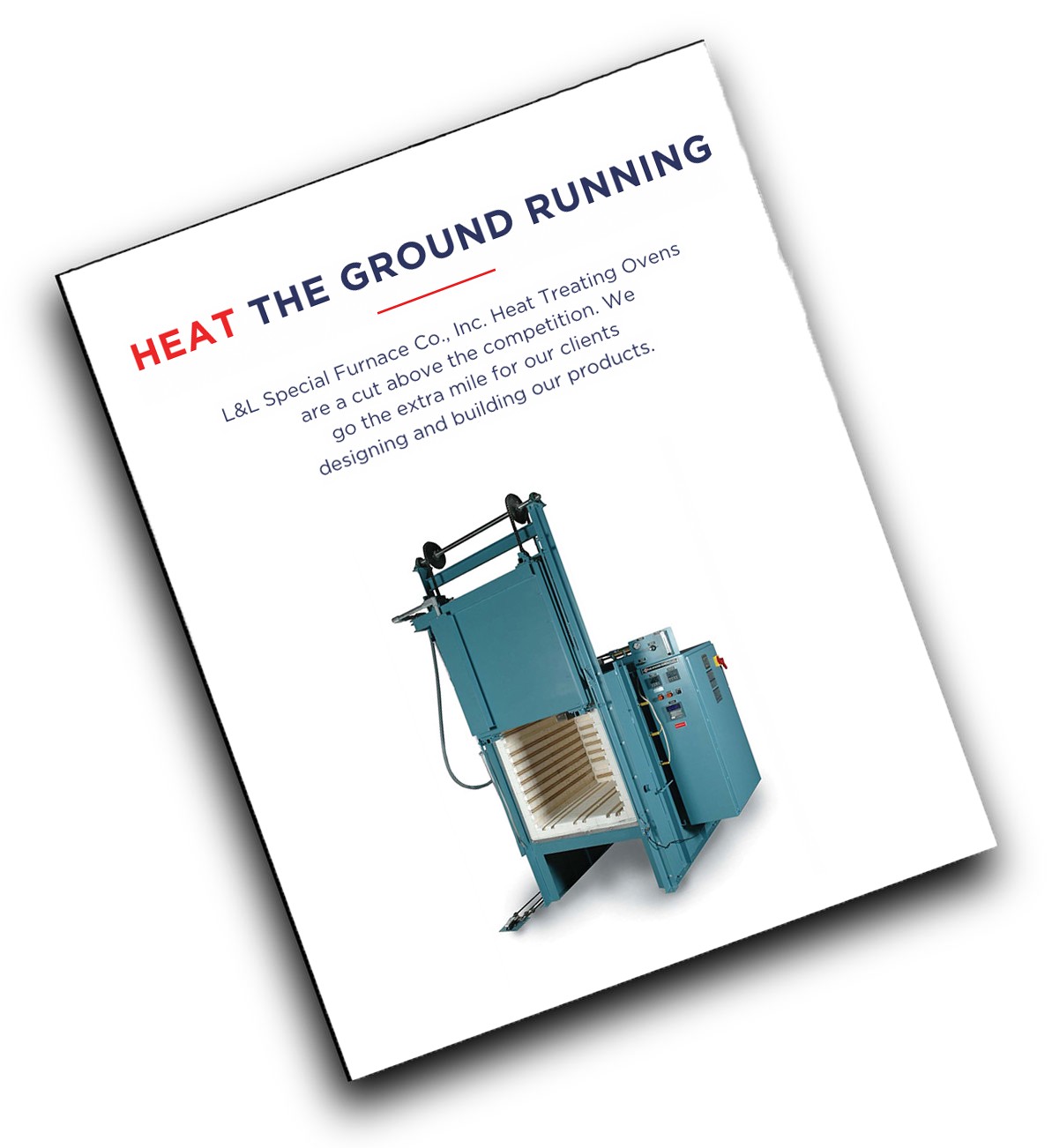
We hope you found this article informative and engaging. At L&L Special Furnace, we are dedicated to providing high-quality industrial furnace solutions tailored to meet your specific needs. With decades of experience and a commitment to innovation, we strive to deliver exceptional products and services to our valued customers.
For more information about our products, visit our Series page. Need help with your current heat treating solution? Contact us today to speak with an expert who can help.
Interested in working with us?
Sometimes it is easier to talk to someone directly. Provide us basic contact information. We'll be in touch